
Aeration for Clay Soil Indiana: Does It Really Work?
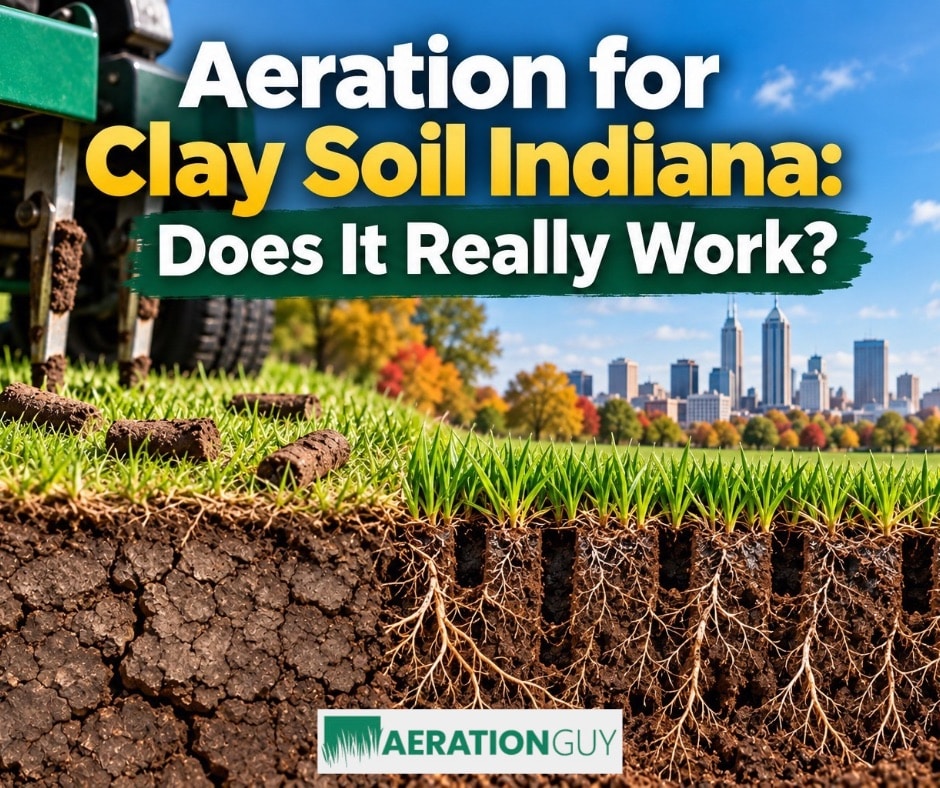
Aeration for clay soil Indiana homeowners deal with can make a significant difference in lawn health, especially when dense, compacted soil prevents air, water, and nutrients from reaching grass roots. Core aeration removes small plugs of soil, creating openings that help relieve compaction and improve growing conditions beneath the surface.
But does aeration really work on Indiana’s stubborn clay soil, or is it just a temporary fix? At Aeration Guy, we help Indianapolis and Central Indiana homeowners understand what core aeration can realistically accomplish and when it makes the biggest difference.
Why Is Clay Soil So Common in Central Indiana?
Much of Central Indiana has soils influenced by glacial deposits, including areas with significant clay content.
Unlike sandy soil, clay contains extremely fine particles that can hold substantial amounts of water. When clay-rich soil becomes compacted, the spaces between soil particles shrink.
This creates several challenges for grass roots.
Water may move through the soil more slowly, oxygen availability can decrease, and roots may struggle to penetrate dense areas.
For homeowners in Indianapolis, Carmel, Fishers, and surrounding communities, these underground conditions can contribute to poor turf performance.
Why Clay Soil Becomes Hard After Dry Weather
Have you noticed that your lawn feels almost like concrete during a dry Indiana summer?
Clay-rich soil can become extremely firm as moisture levels decrease.
However, hard soil doesn’t always mean severe compaction. Natural soil texture and moisture levels also influence firmness.
That’s why evaluating the actual soil conditions matters before deciding how to address the problem.
How Does Aeration in Indiana Work?
Core aeration uses a machine equipped with hollow tines to remove small cylinders of soil.
Unlike spike aeration, which pushes soil aside, core aeration physically removes material from the ground.
This process creates temporary openings that can improve air exchange and water movement while reducing compaction in the treated layer.
For clay-heavy lawns, those openings can make a meaningful difference.
Core Aeration Creates Space for Root Development
Grass roots need oxygen, moisture, and physical space to grow.
When soil becomes compacted, root growth can become restricted.
Core aeration helps loosen the compacted root zone by removing soil plugs and creating channels through the surface.
As a result, roots may have better opportunities to grow through previously dense areas.
However, the improvement depends on soil conditions, aeration depth, and the severity of compaction.
Does Aeration Improve Drainage in Indiana Clay Soil?
Yes, core aeration can improve water infiltration when surface compaction is contributing to poor drainage.
The openings allow water to enter the soil more readily instead of remaining on the surface.
However, there is an important limitation.
If your lawn sits over naturally slow-draining subsoil, has poor grading, or experiences a high water table, aeration alone may not solve standing-water problems.
For example, a low section of a Noblesville backyard may continue collecting water even after thorough aeration.
That’s because the underlying issue could involve landscape elevation rather than compaction.
Aeration is useful, but it isn’t a substitute for correcting serious drainage problems.
Why Proper Aeration Depth Matters for Clay Soil
Not all aeration treatments produce the same results.
According to Purdue University Extension, effective core aeration generally involves holes approximately 2 to 3 inches deep, with roughly 20 to 40 holes per square foot.
These recommendations highlight two important factors: penetration and coverage.
If an aerator only scratches the surface of hard clay, it may provide limited relief.
Likewise, a few scattered holes may not adequately address compaction across the lawn.
Professional equipment and suitable soil moisture can help produce more consistent results.
Should Indiana Clay Soil Be Wet Before Aeration?
Clay soil should generally be moist but not saturated when aerated.
Extremely dry soil may resist tine penetration, resulting in shallow holes or incomplete plugs.
On the other hand, excessively wet clay can smear along the sides of aeration holes. Heavy equipment may also leave ruts or create additional compaction.
For Indianapolis homeowners, timing aeration around soil moisture conditions is often more important than choosing a particular calendar date.
Can Aeration Permanently Fix Compacted Clay Soil?
Core aeration provides relief, but its effects are not necessarily permanent.
Over time, soil can settle, and repeated foot traffic or heavy equipment may contribute to renewed compaction.
This is particularly relevant for busy family backyards where children, pets, and outdoor activities concentrate traffic in certain areas.
Some lawns benefit from periodic aeration, while others may not require treatment every year.
The appropriate frequency depends on soil conditions, traffic, and how the turf responds.
When Aeration for Clay Soil in Indiana May Not Be Enough
Although core aeration is effective for many compacted lawns, it has limitations.
Aeration may provide limited improvement when:
Compaction extends well below the reach of standard aerator tines.
Poor grading causes water to collect in low areas.
Buried construction debris restricts root growth.
Turf struggles primarily because of excessive shade.
Soil remains saturated due to an underlying drainage problem.
Understanding these limitations helps homeowners avoid paying for treatments that won’t address the actual cause.
Is Professional Core Aeration Worth It for Indiana Clay Soil?
For lawns affected by compaction, professional core aeration can be a worthwhile investment.
The main advantage is that it addresses the physical condition of the soil rather than simply treating visible symptoms.
However, results depend on proper equipment, soil moisture, hole depth, and coverage.
A professional aeration service can also help homeowners understand whether compacted soil is likely contributing to their lawn problems.
For Central Indiana properties with clay-heavy soil, that specialized knowledge can make a difference.
Give Your Indiana Clay Soil Room to Breathe With Aeration Guy
So, does aeration really help Indiana clay soil?
Yes. Core aeration can reduce compaction, improve air and water movement, and create better conditions for grass roots. However, it works best when compaction is the actual problem and the treatment is performed under suitable soil conditions.
At Aeration Guy, we specialize in professional core aeration for homeowners throughout Indianapolis and Central Indiana.
We understand the challenges of dense clay soil and focus on helping lawns develop healthier growing conditions beneath the surface.
Ready to improve your compacted lawn? Contact Aeration Guy today to learn more about professional core aeration in Indianapolis, Carmel, Fishers, Noblesville, Westfield, and surrounding communities.