
Double Pass Core Aeration: Why Some Lawns Need It
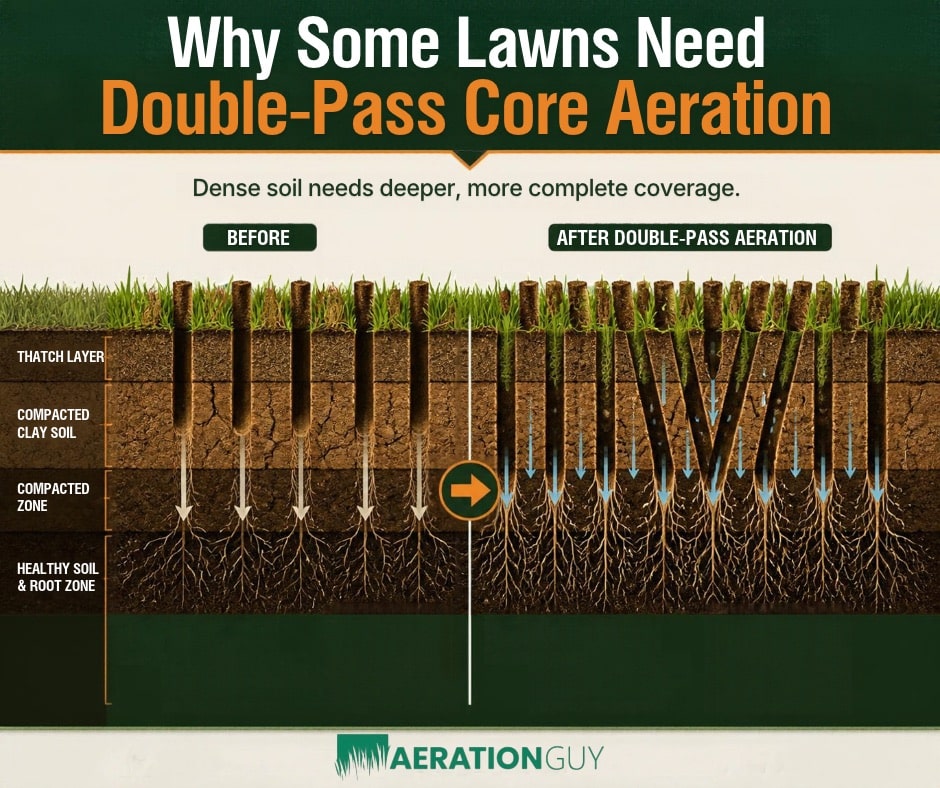
Ever noticed that some parts of your lawn feel harder than others, even after aeration? Double pass core aeration can help when a single pass doesn’t create enough holes to relieve soil compaction effectively. By running a core aerator across the lawn a second time, professionals can increase hole density and improve coverage in areas that need additional attention.
For homeowners in Indianapolis and Central Indiana, this can be particularly useful in yards with dense clay soil, heavy foot traffic, or construction-related compaction.
At Aeration Guy, we believe effective aeration isn’t about running a machine across your lawn and calling it done. It’s about creating the right conditions beneath the surface.
What Is Double Pass Core Aeration?
Double pass core aeration means running a core aerator across the same lawn area twice, typically in different directions.
During each pass, hollow tines remove small cylinders of soil. These openings allow air and water to move more easily into the root zone.
The second pass creates additional openings between those formed during the first treatment.
However, two passes aren’t automatically necessary for every lawn. The goal is to achieve adequate hole density and depth without unnecessarily disturbing the turf.
Why Some Indianapolis Lawns Need Extra Aeration Coverage
Not every lawn experiences the same amount of compaction.
A quiet front yard may have relatively loose soil, while a backyard used daily by children and pets may become considerably denser.
Here are three situations where additional aeration coverage may be beneficial.
1. Heavy Foot Traffic Creates Compacted Areas
Think about the route your family takes from the back door to the patio.
Now imagine walking that same route hundreds of times throughout the year.
Repeated pressure can gradually reduce the pore spaces between soil particles. As those spaces shrink, water infiltration and root growth may become restricted.
High-traffic areas around gates, patios, playgrounds, and backyard pathways may benefit from additional core aeration coverage.
2. Indiana Clay Soil Can Resist Aerator Penetration
Clay-rich soil is common throughout Central Indiana.
When clay soil becomes dry, it can harden considerably. When it becomes excessively wet, it is more vulnerable to compaction from foot traffic and equipment.
These conditions can make aeration challenging.
A second pass may improve coverage when the soil is suitably moist and the first pass achieves adequate penetration.
However, if the ground is too hard for the aerator to penetrate properly, another pass alone may not solve the problem.
3. New Construction Can Leave Soil Compacted
Many newer Indianapolis-area neighborhoods have lawns established over soil disturbed during construction.
Heavy machinery, grading equipment, and repeated vehicle traffic can compact the ground before grass is ever planted.
Some properties also have limited topsoil over dense subsoil.
Double pass core aeration may help address compaction within the reach of the aerator. However, severe or deeper construction-related compaction may require additional soil management.
How Double Pass Core Aeration Improves Hole Density
One of the biggest advantages of a second pass is increased hole coverage.
Purdue University Extension recommends approximately 20 to 40 aeration holes per square foot, generally reaching 2 to 3 inches deep.
Depending on the equipment, a single pass may not create enough holes to approach that recommendation.
A second pass can increase the number of openings and distribute them more evenly across the lawn.
That doesn’t mean twice the passes always produces twice the benefit. Equipment performance, soil conditions, and existing hole density all influence the results.
Why Aeration Direction Matters
When performing two passes, changing direction can help create a more evenly distributed pattern.
For example, a technician might complete the first pass lengthwise and the second pass across the lawn.
This cross-pattern approach can place additional holes between those created during the first pass.
The result is more consistent coverage across the treated turf.
However, obstacles, slopes, sprinkler systems, and landscape features may influence the direction and pattern used.
Is Double Pass Core Aeration Always Better?
Not necessarily.
A second pass should serve a purpose.
If a lawn already has sufficient hole density and penetration after one pass, additional aeration may provide limited benefit.
Likewise, running heavy equipment over saturated soil can create ruts or cause further compaction.
The ideal approach considers:
Existing soil compaction
Soil moisture at the time of service
Hole depth and density
Aerator design and performance
Turf condition and traffic patterns
The best aeration treatment is the one that addresses the lawn’s actual needs.
How Do You Know If Your Lawn Needs Double-Pass Aeration?
Start by observing how your lawn responds to everyday use and rainfall.
Does the ground feel unusually hard? Does water collect in heavily traveled areas? Are certain sections noticeably thinner than the surrounding grass?
These symptoms may indicate compaction, although poor drainage, shade, or other soil problems can produce similar results.
A professional can also evaluate soil moisture, penetration, and the number of holes produced during the initial aeration pass.
Rather than assuming every lawn needs two passes, the decision should be based on whether additional coverage will meaningfully improve the treatment.
Get the Right Core Aeration Coverage With Aeration Guy
Double pass core aeration can be a valuable option for compacted lawns, particularly when one pass doesn’t provide adequate hole density.
But more passes aren’t always the answer. Proper depth, soil moisture, equipment, and coverage are equally important.
At Aeration Guy, we specialize in professional core aeration for homeowners throughout Indianapolis and Central Indiana. Our focus is understanding soil conditions and helping homeowners get the most from their aeration service.
Whether your lawn needs additional coverage or a standard core aeration treatment, we’re here to help you make an informed decision.
Ready to address compacted soil beneath your lawn? Contact Aeration Guy to learn more about professional core aeration in Indianapolis and surrounding communities.